Error Event
Introduction to BPMN Error Events
In the Business Process Model and Notation (BPMN) standard, an error event represents a specific error condition that occurs during the execution of a process. Error events are used to handle exceptional situations and provide a mechanism for error handling and recovery within a business process.
Types of Error Events
Error events can be used in different contexts within a BPMN process:
-
Error Start Event: Initiates a process instance when a specific error is received. This can only be used to start an event subprocess, not a top-level process.
-
Error Boundary Event: Attached to an activity, it interrupts the activity when a specific error occurs and redirects the flow to an error handling path.
-
Error End Event: Ends the current process path and throws a specific error that can be caught by an error boundary event or an error start event in an event subprocess.


Configuration for Error Events
To configure an error event, you need to specify the error in the general tab of the properties panel:
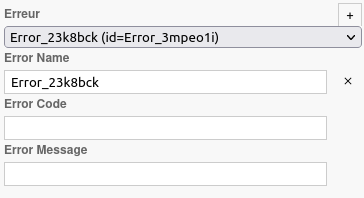
Error Start Event Configuration
For an error start event (which can only be used in an event subprocess):
-
If no error is specified: The event subprocess will be triggered for any error thrown in the parent process.
-
Error Code: Contains the error code that will be used to match with thrown errors.
-
Error Message: Contains the error message that will be displayed with the error.
Error Boundary Event Configuration
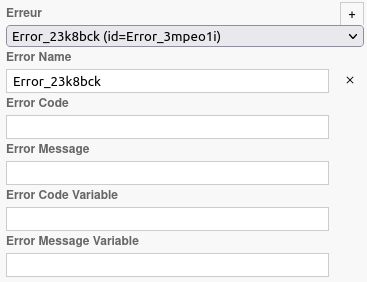
For an error boundary event:
-
If no error is specified: The event will be triggered for any error thrown by the activity it is attached to, without considering a specific error or error code.
-
If an error is specified: The event will only be triggered for errors that match the specified error code.
-
Error Code Variable: If specified, the error code of the caught error will be stored in this variable.
-
Error Message Variable: If specified, the error message of the caught error will be stored in this variable.
Use Cases for Error Events
Error events are commonly used for:
-
Exception Handling: Handling exceptional situations that occur during process execution.
-
Error Recovery: Providing a mechanism for recovering from errors and continuing the process.
-
Process Termination: Terminating a process or subprocess when an unrecoverable error occurs.
-
Error Notification: Notifying relevant stakeholders about errors that occur during process execution.
Listeners
It is possible in a BPM model, regardless of the configurable element, to define listeners via the appropriate tab.
Execution Listener
An execution listener is created by clicking the plus + button in the list of concerned listeners in the tab.
It applies its Groovy script at the activation or the completion (depending on the user’s choice) of the event. The script can be written with or without the script builder.